Spider-Man: Brand New Day × Google Maps: A Film Promotion Built into a Daily Habit
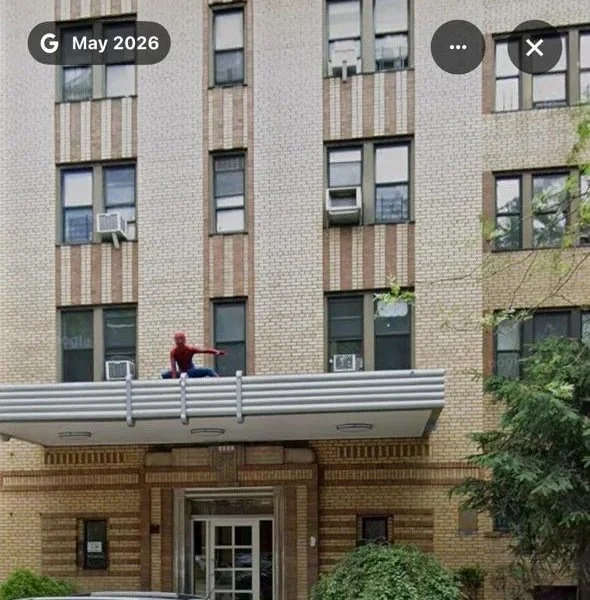
The payoff: Spider-Man crouched on an entrance awning at 43-25 43rd St, Queens — one of five “Spidey Sightings” staged in Google Street View.
On the road, US · August 2026 · Mobile · Entertainment · Sony Pictures · Google Maps · Spider-Man: Brand New Day · Marvel
Thinkers: Robert Zajonc · George Loewenstein · Jerry Suls · Al Ries · Jack Trout · Les Binet · Peter Field
A close read of the Spider-Man: Brand New Day “Spidey Tracker” experience inside Google Maps — why it doesn’t feel like advertising, what it asks of the people who follow it, and where the payoff quietly splits between casual viewers and die-hard fans.
I first noticed the Spider-Man placement on Google Maps while sitting in the passenger seat on a road trip with my husband — Ames to Chicago, and later Las Vegas to San Francisco. He was driving; I had my own phone in hand, not the navigation mounted on the dash. I had enough attention to look at the screen, but it wasn’t dedicated attention — there was the road, conversation, the scenery, everything else that comes with being in a moving car. I’d opened Maps for something completely ordinary when, inside the “Local vibe” section, I noticed a small Spider-Man icon with the words “Spider-Man: Brand New Day · 5 places.” It didn’t initially feel like a movie ad interrupting what I was doing. It looked more like something that belonged inside Maps — which was probably why I stopped long enough to wonder what the five places were.
The 10-second decode
Mechanism: A Spider-Man: Brand New Day card under Maps’ “Local vibe” opens a Curiosity Gap: you notice a gap between what you know and what you want to know, and you want it closed. It’s a Spidey “sighting”, clearly a film promotion but an unusual one, and the urge to resolve it pulls you through the tap, the list and the clue. Street View pays it off with Incongruity Resolution: a superhero crouched on an ordinary Queens awning looks out of place until you work out why he’s there (“the former home of Spider-Man”). Working it out is the reward.
Brand move: Sony rides Google’s daily reach through Narrative-to-Real Transposition, where something real inside the film’s story is carried into your world. Fans get Ned’s role (Peter Parker’s best friend, who tracks Spider-Man in the film), with Maps as the tracker and the Street View car “catching” Spider-Man in action. Google gets a seat in the film’s cultural moment.
Trade-off: Built to engage, not to convert. No release date, no ticket link; the only button is “Save list”, so nothing moves you to click and book now. The card reaches everyone, but the full reward (why this address, Ned’s role) only lands with fans. And Maps serves New York content under “Local vibe” to people nowhere near New York.
Finding worth remembering: Build your promotion into an app people use every day, in a way anyone can enjoy, and you reach all its users, not just your fans. Spider-Man turned Google Maps into a place to play.
The Brief
Brand / Property: Spider-Man: Brand New Day, Sony Pictures / Marvel
Category: Entertainment › Platform partnership
Market / Geography: Nationwide, via Google Maps’ existing US user base — with content staged specifically in New York, encountered here nowhere near it (Iowa/Chicago corridor; Las Vegas/San Francisco corridor).
Objective: Sustain awareness and engagement across a long theatrical window without incremental paid media spend. (Inferred, not confirmed.)
Mechanism: Persuasion Knowledge Activation Suppression (lead) → Von Restorff Effect → Schema Activation + Affect → Curiosity Gap → Incongruity (system-level, then scene-level) → Goal Gradient Priming. Full chain in Decode.
Spend model: Partnership — native platform integration; no visible paid media buy. (Inferred, not confirmed.)
Competitive set: Not treated as a conventional media competitive set; comparable film/platform integrations would need to be established separately.
Target audience: Broad Spider-Man-aware audiences — the mechanism catches everyone equally; only the payoff is fan-gated.
Placement: Google Maps, “Local vibe” / Spidey Sightings feature, and Street View.
Spotted: Twice — August 20, 2026 (Iowa to Chicago highway corridor) and August 23, 2026 (Las Vegas to San Francisco corridor), 20 and 23 days respectively after the film’s July 31, 2026 theatrical release. Both well past the opening window, into sustained rather than launch-burst timing.
CTA: None present — engagement resolves at task completion (finishing all five sightings); nothing routes the user toward theater, showtime, or ticket information from there.
Stakeholders: Sony Pictures / Marvel, Google Maps, Samsung. Samsung’s role is sourced (the tracker is inspired by Ned’s phone) but not visible on screen in this execution.
This is technically a film promotion, but calling it simply a Google Maps ad misses what the partnership is doing. Sony is using Google’s existing Maps behavior and enormous user base to put a newly released movie in front of people who may never have gone looking for it. Most users don’t need to tap anything for Sony to get value from the placement; seeing Spider-Man inside a product they already open regularly is another awareness exposure. But Google is contributing more than audience access. Its maps, location markers, and Street View functionality become the environment through which the movie can actually be explored. Samsung’s role connects the experience back to the technology Ned uses in the film. The exchange is therefore more interesting than a brand simply buying inventory: Sony brings the story and the audience; Google provides the platform and behavior; the user supplies the participation.
Before the ad
A newly released movie has a very familiar marketing problem: getting people to know it is coming is one thing; keeping it mentally present once it has arrived is another. The audience doesn’t stop encountering entertainment choices just because a film has opened, and Sony is competing for attention against every other film, show, creator, and cultural moment fighting for that same mental space. A conventional movie ad can buy another impression, but this partnership offers something slightly different. Instead of asking people to leave their normal behavior and enter a movie advertisement, Spider-Man is inserted into a behavior that already exists — opening Google Maps. The opportunity is therefore not only to create awareness at scale, but to make that awareness more interesting by giving people something they can actually do with the property.
Sony doesn’t need help getting Spider-Man noticed; the character is recognized on sight. The harder problem is getting people to act: to go from seeing Spider-Man to looking for him.
Decode
The placement has two advantages: it’s in an app people open anyway, and it arrives differently from most promotions.
The first needs nothing from you. People open Google Maps every day, so the card gets seen again and again. Psychologist Robert Zajonc called this the mere exposure effect: repeated exposure builds familiarity, and often liking, on its own, even if you glance at the card and keep scrolling.
The second is how it arrives. The card shows up in “Local vibe”, where Maps puts the weather and places worth knowing nearby, in the same format as everything else, with no “Sponsored” label. You can tell it’s a film promotion, since the title is right on the card, but it reads like something Maps is recommending, not something interrupting you.
What you actually see first is small — just an icon and a line of text. But because your guard was never raised, even this little is enough to register, the way a familiar face gets picked out of a crowd before you’ve consciously looked for it. And it gives you a number. “5 places” turns a vague impression — there might be some Spider-Man thing around here — into something bounded and exact: five things, though you don’t know what or where. Economist George Loewenstein’s research on curiosity found that this is exactly what makes an unknown hard to ignore — not vagueness, but a felt, bounded gap with a defined edge to it.
That small curiosity is what carries you into pulling the sheet up further, and only now does the fuller card appear — hero image included, Spider-Man mid-leap over the city. The recognition that was quick and light a moment ago deepens into something closer to feeling; the image’s motion and energy color how open you are to whatever comes next, without you consciously deciding to feel that way.
Tap into “Spidey Sightings,” and the five places become real — pins scattered across an actual map. This is the moment worth slowing down on, because it’s not just a visual reveal; it’s a handoff of role. Inside the film, this exact device — tracking Spider-Man’s location — is what Ned Leeds uses, so the moment you’re hunting pins yourself, you’re not simply consuming a reference to that behavior; you’re briefly performing it.
That handoff doesn’t land the same way for everyone, and it’s worth being precise about where the line falls. Nothing about noticing the pins requires knowing anything about Ned or his tracker — that part works on anyone glancing at the screen. What depends on the reference is what the moment means once you’re in it. For someone who knows the film, stepping into Ned’s role is the payoff itself. For someone who doesn’t, it just reads as an unusual, mildly interesting Maps feature — noticeable, but with less reason to see it through. The fan isn’t who this is built to catch. Everyone’s already caught by this point. The fan is who it’s built to reward.
Alongside that, something else happens in the same glance: the pin reads instantly as an ordinary location marker, the same fast read your eye makes for any pin on any map — but at the same moment, something about it doesn’t sit right, because a superhero isn’t the kind of thing that belongs in a system built to mark real, physical places. Psychologist Jerry Suls described this kind of mismatch as incongruity — nothing wrong with the object itself, just a violation of the logic of the system it’s sitting inside, and that quiet friction is enough to make you look twice.
And seeing five real pins on a real map changes what resolving the gap actually feels like. A minute ago, “5 places” was abstract. Now you can see exactly where each one is — which means you can see exactly what finishing this looks like. Five taps, not an open search. That’s the goal gradient effect at work, a pattern going back to early motivation research and since carried into loyalty and rewards design: motivation to finish something rises the moment the remaining distance becomes visible and small, often before any actual effort has been spent.
Open one, and the payoff arrives — Spider-Man standing inside what’s otherwise a completely ordinary Street View scene. This lands harder than it would almost anywhere else, because you already carry a strong, years-old expectation of what Street View looks like: candid, unstaged, nobody posing for the car. A costumed figure standing there doesn’t just add something unusual to the frame — it breaks the expectation that this kind of image is unplanned. Same quiet mismatch as the pin, just relocated: this doesn’t belong here either.
And this is where the loop closes in a way that keeps you moving instead of stopping you. Finding one location resolves the curiosity attached to it specifically — but “4 left” is still visible. Having just found one, you now know exactly what you’re looking for and exactly how much remains, which is stronger the second time, not weaker — you’ve already proven to yourself the payoff is real, so the rest feels like a short list to clear rather than an open search. Each pin found is simultaneously an ending, for that one gap, and a reason to keep going, for the whole set.
The brand lens
This partnership is best read as a three-way value exchange, where each party is solving a distinct strategic problem rather than simply lending its name to the others.
For Sony, the objective is audience access at scale without incremental media spend — placing the film’s IP inside a platform with an existing, habitual user base, rather than buying reach through conventional channels. The strategic gain isn’t just impressions; it’s distribution inside a behavior the audience already performs daily, which is a materially more efficient acquisition path than most paid media can offer.
For Google, the campaign does two jobs, and both are defensive: in Al Ries and Jack Trout’s terms, the moves a market leader makes to protect its position rather than take new ground.
First, it gets Google’s own users to explore features many rarely touch. Every clue says “Use Street View”, every sighting is a pin, and the whole hunt lives in a shared list you can save. A film promotion becomes a guided tour of Maps beyond directions. It’s a retention play: the goal is deeper habits among existing users, so Maps becomes harder to replace. Second, attaching Maps to a high-visibility film protects against a risk every long-standing utility app faces: being seen as old infrastructure rather than a product people still find interesting.
For the user, the value exchange is participation itself — briefly stepping into Ned’s own tracking role from the film, rather than just viewing a reference to it, which is also what makes the experience stick in memory afterward in a way a normal ad wouldn’t.
The trade-off
The campaign is built to engage, not to convert. There’s no release date and no ticket link; from a performance point of view, nothing moves you to click and book now. Any ticket sale this drives happens later, in another channel, and can’t be traced back here. In the terms of advertising-effectiveness researchers Les Binet and Peter Field, this is brand building, not sales activation.
The audience fit is more specific than “this is for fans”. Finding Spider-Man works for anyone, because the clue gives you the address. What only fans get is the meaning: why this address matters, and why tracking him is Ned’s job in the film.
Maps also serves this New York content under “Local vibe” to people nowhere near New York. The hunt still works, since Street View runs from anywhere, but the label promises something local that isn’t.
Finally, a five-stop hunt asks for more follow-through than a quick glance at Maps usually gets. Some people will find one sighting and stop there.
Media & channel
The biggest advantage isn’t a psychological trick — it’s raw scale. An enormous number of people open Google Maps every day, so placing content there produces repeated exposure without paying to chase anyone down through separate ad buys. That repetition builds familiarity on its own, purely through frequency, riding on a habit that already existed before the campaign did.
Most paid placements have to buy that repetition, flight after flight. Here it comes free — and if this has been live longer than a typical paid flight would run, that points toward something built to last the length of the film’s cultural window, closer to a platform feature than a time-boxed media buy.
Test
Three things can be measured here: how far people followed the hunt, what the campaign changed in people’s minds, and what it can’t prove.
What Google’s app data can show. Google’s normal app analytics can show how many people opened “Spidey Sightings”, and how many then opened Street View at one, some, or all five locations. That completion rate shows how far people followed the hunt, with no survey needed.
What a survey can show. Google shows the card to one group and holds it back from a similar group, then asks both the same questions. The difference between the two is what the campaign changed. Only Google controls who sees the card, so only Google could run this test. Unless it was part of the deal, Sony gets engagement numbers, not proof of lift. Start by asking whether people have already seen the film, because the right questions depend on the answer.
Message association (everyone): “What do you think this feature was based on or inspired by?” Keep it open-ended. “Spider-Man” means the hunt worked. “Ned’s tracker” means the film connection landed too. My guess: most people give the general answer.
Unaided salience (haven’t seen it): “Which films can you think of that are in theaters right now?”
Aided release awareness (haven’t seen it): “Which of these films are showing in theaters now?” (a list including Brand New Day)
Intent to watch (haven’t seen it): “How likely are you to see Spider-Man: Brand New Day in theaters?” During a release window, this matters more than a general “do you like the film” score.
Reinforcement (already seen it): “Did finding the sightings add anything to the film for you?” This measures goodwill and word of mouth, not a first ticket.
What can’t be tested. Ticket sales. As a brand-building piece with no release date or booking link, the campaign can’t prove it led anyone to buy a ticket.
Closing thought
I saw this twice: once between Ames and Chicago, once between Las Vegas and San Francisco, both more than a thousand miles from the five sightings in New York. A campaign about finding Spider-Man in New York found me on a road trip nowhere near it. I noticed it, I remembered it, and I’m writing about it now.
I’ve found one sighting so far, on an awning in Queens. The other four are still waiting.
Seen a brand build itself into an app you already use — a map, a playlist, a search result? Share it in the comments.
Related capture: Spider-Man Took Over Times Square. It Didn’t Need to Say Anything Else. The same film, captured the same month as a paid out-of-home takeover in New York. Read together, the two Decodes show one release campaign working at opposite ends: one built to be impossible to miss, one built to be found.
