Spider-Man Took Over Times Square. It Didn’t Need to Say Anything Else.
A close read of the Spider-Man: Brand New Day takeover I saw in Times Square on August 9 — why this ad never needs a joke, a puzzle, or a hook to work, and what’s actually being bought when recognition is already free.
My husband and I were just taking a late-night walk through Times Square, taking in the lights — Coca-Cola, Gap, dozens of other massive screens all fighting for the same few seconds of attention.
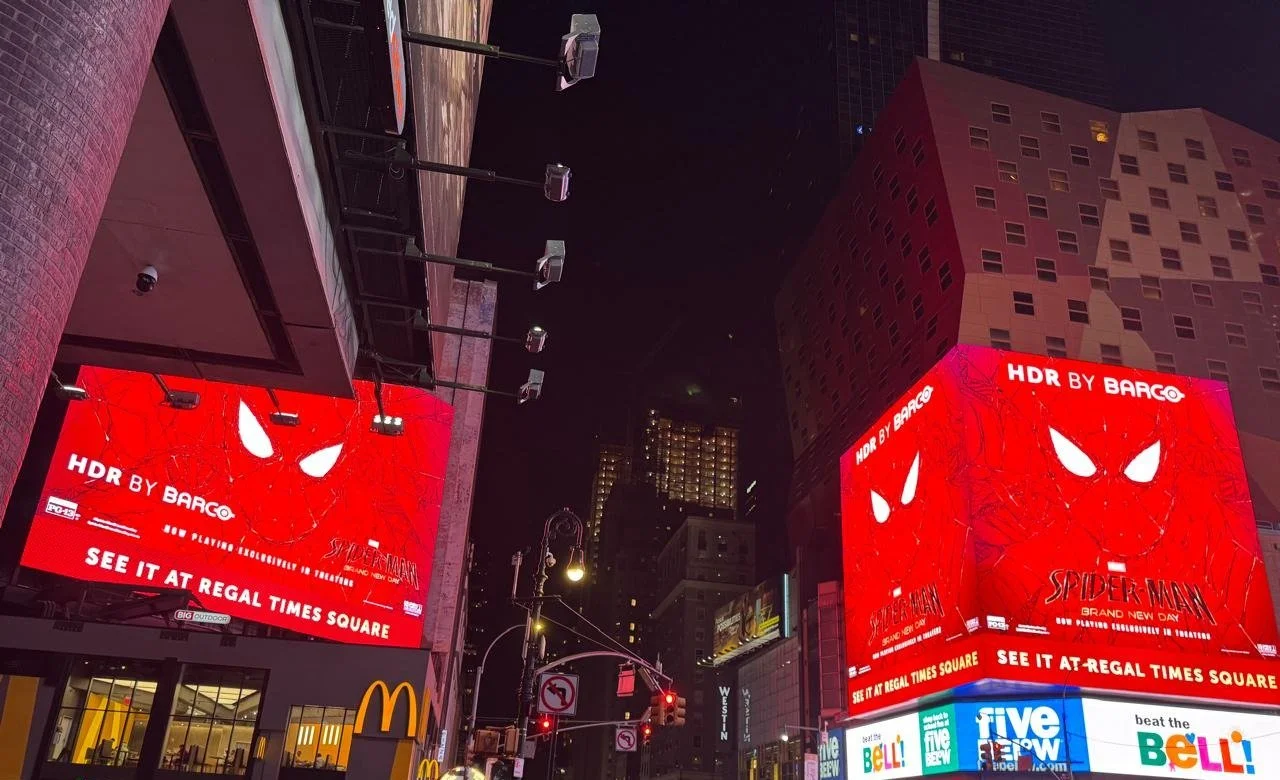
Then, at one corner, two entire building faces went full Spider-Man.
The 10-second decode
Mechanism: Two things are happening here, not one. Your eye has nowhere else to go — two building faces take over the entire field of view. That’s attention working the way it always does: overwhelming stimulus wins by default. The second mechanism is the CTA — See it at Regal Times Square — and it does two different jobs depending on who reads it. For someone who already has ‘watch a movie tonight’ as an open need, the ad works on salience: it’s the most available, hardest-to-miss option, so the vague intention defaults to Spider-Man. That’s what firms the intention — and the same line does something else too, removing the friction to act on it by naming the exact theater, right where they’re already standing, so there’s nothing left to figure out between deciding and going. For someone standing in Times Square with no plan yet, it’s doing something else entirely: the same words enter a consideration set, one option alongside a Broadway show, dinner, or just walking around, all competing for ‘what do we do today.’ This moves that person into a different funnel stage altogether — evaluation of alternatives.
Brand move: Spider-Man already sells itself; the money goes toward urgency, not introduction — see it now, at this specific theater
Trade-off: Expensive, unable to convert anyone undecided, and low-value on repeat views — inside one of the most competitive ad environments anywhere.
Finding worth remembering: When recognition costs nothing, the smart move is to skip persuasion altogether. The CTA’s only real jobs are becoming the default for whoever already needs a movie, and entering the list for whoever doesn’t.
The Brief
Brand / Property: Spider-Man: Brand New Day, Sony Pictures / Marvel
Category: Entertainment › Film
Market / Geography: Times Square, New York — audience-agnostic; no geographic or demographic targeting logic beyond the physical location itself.
Objective: Maximum theatrical salience during the opening window, driven by the studio’s own urgency to capture early box office momentum following the film’s worldwide release on July 31, 2026. Objective itself inferred, not confirmed.
Mechanism: Environmental Takeover (lead) → Motion → Salience (firms intent for viewers already deciding to watch a movie) / Evaluation of Alternatives (consideration-set entry for undecided viewers). Full chain in Decode.
Spend model: Paid media — direct OOH buy, among the highest-cost advertising real estate that exists. (Inferred; exact commercial terms between Sony, Regal, and Barco not confirmed.)
Competitive set: Other theatrical releases competing nationally for the same ticket demand, and the wider entertainment options available in and around Times Square — Broadway, dining, just walking around — competing for the same attention and time. All this happens inside one of the most saturated ad environments on the planet.
Target audience: Broad and audience-agnostic — existing fans, casual moviegoers, tourists, families, anyone exposed to the spectacle. No narrow buyer persona; the objective is volume, not targeting.
Placement: Times Square, New York — two synchronized building faces at street level.
Spotted: August 9, 2026 — my observation date, nine days after the film’s July 31, 2026 release; not a confirmed campaign flight date.
CTA: “See it at Regal Times Square” — a specific-theater directive, not a generic call to action.
Stakeholders: Sony Pictures / Marvel, Regal, and Barco each appear in different roles. The commercial arrangement between them is inferred, not publicly confirmed.
Decode
Spider-Man doesn’t need three seconds to explain who he is. The mask is already a stored mental shortcut — the character, the colors, the cultural weight, all filed away years ago. So there’s nothing here to figure out. No joke to get, no curiosity gap to open, no incongruity waiting to resolve. It just says: Spider-Man is here.
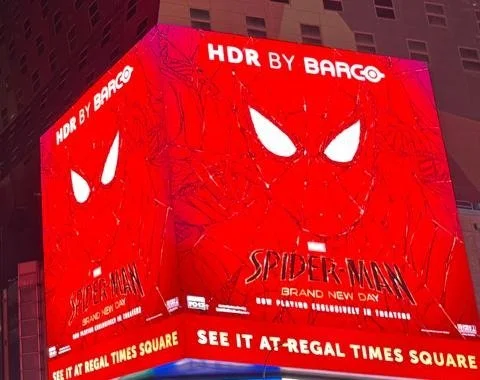
The takeover works by sidestepping the contrast game altogether, at least while it’s up. Coca-Cola, Gap, dozens of massive displays are all trying to win through contrast — standing out against a shared visual field. This ad wins by removing the field instead. Two full building faces, synchronized, take over the entire space — for those few seconds, there’s no backdrop left to stand out from. That’s Environmental Takeover: removing the surrounding you’d otherwise need to stand out from.

Motion adds a second, independent trigger on top of that. Itti, Koch and Niebur’s research on visual saliency identifies motion as one of several low-level features — alongside color and contrast — that compete for attention before and independent of recognizing what’s actually moving. Scale alone would work on a static board. Motion is a separate automatic pull layered on top of it, and the two aren’t the same lever pulled twice.
Once the eye is caught, recognition happens almost instantly — what cognitive psychologists call Schema Activation — and this is the real pivot point in the whole chain. Everything before this step is stimulus-driven and would work on a completely unfamiliar brand — scale and motion don’t care what’s moving, only that something is. This step is different: it only works because decades of cultural investment are already banked in memory. Neuroscientists Corbetta and Shulman describe this as a hand-off between two separate attention systems — one driven by the stimulus itself, one driven by stored memory and goals. Nothing before this moment needed Spider-Man specifically. This moment needs nothing else.
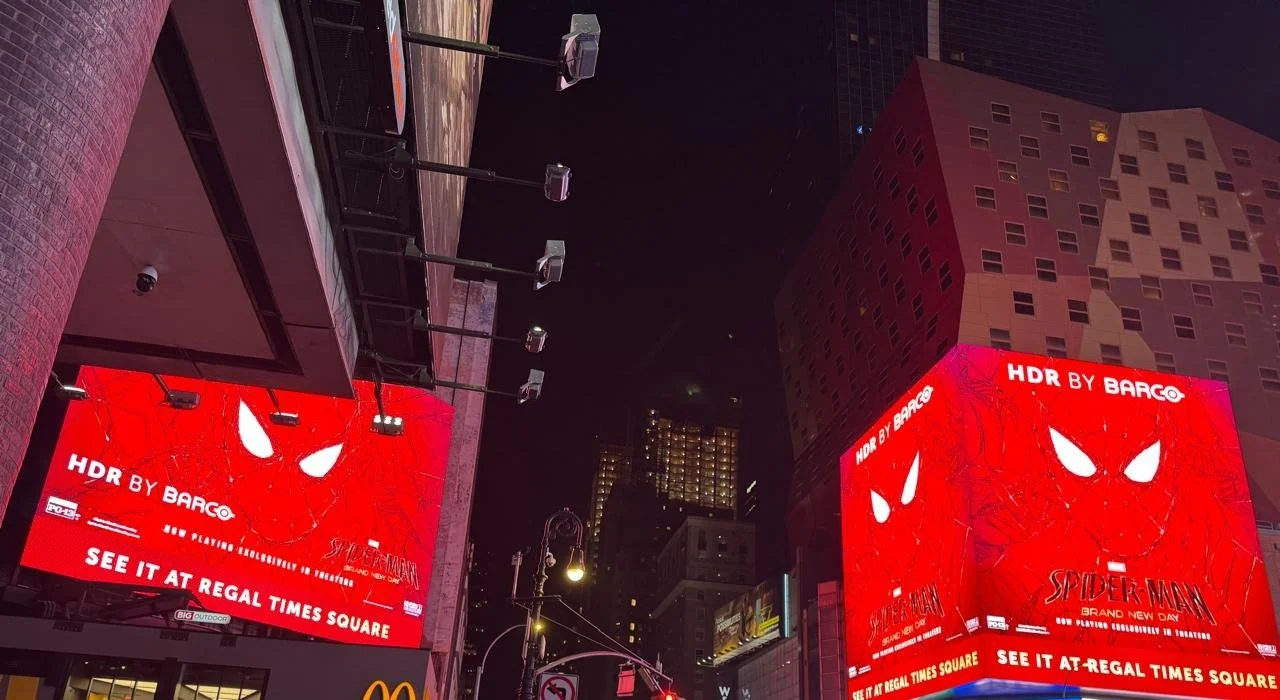
So everything above is engineered for maximum results in minimum processing time. Two synchronized building faces aren’t only “bigger” — Times Square is a plaza people enter from every direction, and a single building face has blind sides. Running the same creative on two separate structures at the corner means almost no approach misses it, solving a directional coverage problem. And the technical coordination required to synchronize animation across two independently built structures is its own quiet signal. The scale of the execution functions as a proxy for the scale of the movie, the same logic as a trailer’s visible effects budget implying a big-budget film.
The screen displays red and the mask for a few seconds. The only text is bold, short, and white: NOW PLAYING EXCLUSIVELY IN THEATRES. SEE IT AT REGAL TIMES SQUARE. The red is Spider-Man’s established costume color, reinforcing an identity already stored in memory. The copy is short because the exposure window is short — viewers have only a second or two, so the message has to be readable instantly. Because the CTA names a specific theater, it creates a low-friction path to conversion, routing viewers to a theater likely within walking distance of where they’re standing — a tighter link between seeing the ad and buying a ticket than most out-of-home formats achieve.
One more layer extends past the physical placement entirely. People don’t just walk through Times Square — they photograph it, film it, post it, unprompted. The studio buys the physical exposure; the environment generates a second, unpaid layer of exposure on top of it, through social distribution rather than additional spend. Worth naming as its own mechanism — audience-as-distribution — since it’s genuinely distinct from anything a quieter location could produce.
The brand lens
Three separate objectives are stacked on one screen — Sony and Marvel’s, Regal’s, and Barco’s — each distinct enough to warrant its own explanation.
Sony and Marvel’s objective is opening-window urgency. The recognition problem doesn’t exist — it was solved years ago — so the spend goes toward making the film feel inescapable during a narrow window. The placement itself is also doing communicative work separate from anything on screen: a tentpole studio taking over two full building faces is a statement of scale, independent of the creative content. A small poster says here’s a movie. A takeover like this says this is an event — a viewer infers that from the sheer scale of the behavior itself.
Regal’s objective is specific behavioral routing. The CTA names an exact theater — see it at this exact theater — an exhibitor-partnership objective layered on top of the studio’s, only logical because the theater is within the same Times Square vicinity as the billboard itself.
Barco — a cinema technology brand that is largely invisible to consumers — gains visibility through its association with Spider-Man. The strength of that association, however, depends on whether viewers notice and process the relatively small ‘HDR by Barco’ attribution within the larger Spider-Man execution.
The trade-off
This campaign guarantees reach. That guarantee comes at three real costs, each built into the strategy itself.
The first is a direct cost: extreme cost-per-impression. Times Square OOH is among the most expensive advertising real estate that exists, and that spend only makes sense if the secondary, earned-media effect — people documenting and sharing the takeover unprompted — is actually materializing at scale.
The second is an opportunity cost. The ad communicates zero information that differentiates this installment from any other Spider-Man film — no plot hook, no character beat, nothing beyond Spider-Man, playing now, here. That’s a deliberate choice: the film already made its case to the culture years ago. But it means giving up any chance of persuading someone unfamiliar with the franchise, or someone who might not go without knowing anything about the plot — whatever incremental ticket sales that persuasion could have captured are simply left on the table.
The third is a diminishing-returns cost. There’s nothing here that rewards a second look — no additional detail to notice, no joke to catch on rewatch, nothing held back from the first glance. Because of that, any impression beyond someone’s first exposure delivers close to zero additional value — repeat viewing is close to wasted spend. That forces the campaign into a media logic built on constant turnover: fresh audiences cycling through Times Square, again and again.
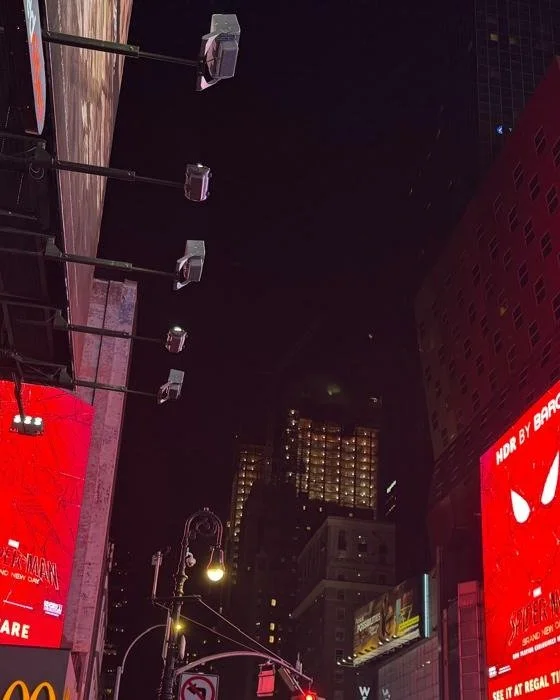
Below all the costs is the most contested attention environment. Dozens of massive, moving, brightly lit screens are fighting for the same few seconds on every side of the same block. The Spider-Man ad can win pedestrian attention — but that win is persuasion color, contested freshly every few seconds. The next screen is already pulling the next eye away.
Street-level ambience from the same Times Square visit, showing the density of competing screens around the Spider-Man takeover.
Media & channel
Repetition plays a different role here than its usual job in advertising theory. Spider-Man doesn’t need repeated exposure to build recognition from zero — that recognition already exists at near-ceiling. What repetition does instead is reinforce presence: this is everywhere, this is happening now. Opening-window salience, not long-game brand building — saturating an existing mental structure during a narrow theatrical window rather than constructing a new one.
The channel logic here is a direct media buy — every impression is paid for, inside an environment built to make any single advertiser’s dominance last only a few seconds. So the visibility is paid, temporary, and limited to the people who happen to be there at that moment. In Times Square, people photograph it, film it, and share it online — extending the campaign’s reach past the physical crowd, for free.
The choice of billboard over, say, a highway placement comes down to who’s standing there. Times Square is pedestrians, on foot, close enough to act the moment they look up.
That’s also why the creative asks so little of itself. The mask’s red eyes are enough on their own — instantly recognizable, no logo or title needed to confirm what this is. The only other thing on the screen is a command: SEE IT AT REGAL TIMES SQUARE.
Test
Three things are worth testing here, and they don’t carry equal weight. One is directly observable through data that already exists. Two require actual research instruments. Worth naming up front, before any of them: because this is a major tentpole on opening weekend, isolating this specific placement’s causal contribution from ordinary opening-weekend demand is close to impossible. What’s testable is whether outcomes are consistent with the placement working — a lower bar than proof of causation.
Occupancy and sell-through. Regal already tracks per-theater box office and seat occupancy as ordinary business reporting — no new research instrument needed. Hypothesis: Regal Times Square runs at or near full capacity through opening week, consistent with a specific-theater CTA doing its job. Worth stating honestly: near-full houses on a Spider-Man opening weekend are likely regardless of this specific installation, since baseline demand for a tentpole release is already high, and the theater has a hard seat-count ceiling no ad can push past. That makes occupancy directly measurable — though the credit for it stays genuinely ambiguous, since baseline demand alone could plausibly produce the same numbers.
CTA registration. Hypothesis: most people will instantly recognize Spider-Man and register the scale, but a meaningful share won’t register that the board pointed to a specific theater at all — the visual spectacle likely consumed their attention before the text ever got processed. Testable the way OOH measurement normally works: geofenced location matching to identify who passed near the installation, followed by a post-exposure survey to that group. The survey asks, in order — did you see the billboard, what was it advertising, and then the real question — did it mention where to see the movie, or just that the movie exists. That last question measures whether the detail was ever noticed at all.
Closing thought
The mask does one thing: it gets recognized instantly. That’s the fastest thing advertising can do — recognition delivered in a single glance, nothing else required.
That’s what several million dollars of Times Square real estate buys once a brand doesn’t need introducing anymore: the loudest possible way of saying still here, still now.
The real task here was always conversion: build salience, turn that into a walk-in at Regal, and turn that walk-in into a box office sale — all within a window that closes the moment the film leaves theatres.