Ramp Made Receipts Funny. I Saw It on My Way Out of O’Hare.
O’Hare, Chicago · August 2026 · OOH · Finance · Ramp
Thinkers: Laurent Itti · Christof Koch · George Loewenstein · Jerry Suls · Richard Petty · John Cacioppo · Byron Sharp · Hedwig von Restorff
A close read of the Ramp OOH ad I spotted at Chicago O’Hare — what made me look, why it works, and where the creative may ask more of the viewer than the media environment can give.
I was heading down the escalator at O’Hare, luggage in hand, on my way out to get my Uber. A few seconds from the exit. Then the yellow caught me.
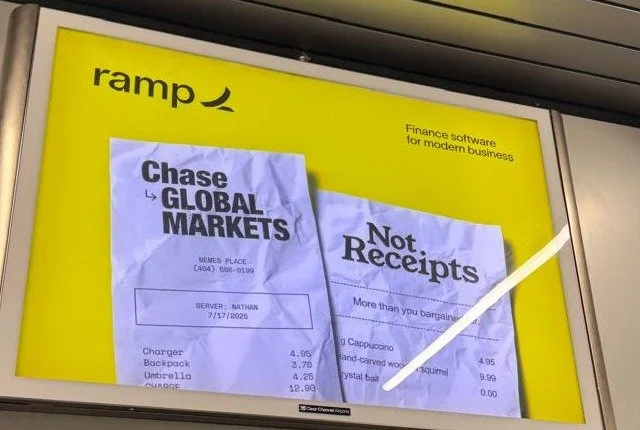
1 · The board. Two crumpled receipts on Ramp yellow, above the escalator down to baggage claim at Chicago O’Hare.
10″ Decode
Mechanism: In a grey airport, Ramp’s yellow stands out; “Chase” on the first receipt can read as the bank, until the second reveals the joke: “Chase global markets. Not receipts.”
Brand move: Software is hard to picture, so Ramp shows the chore it removes, receipts, and points to the bigger work it frees people for.
Trade-off: A glance can catch Ramp’s yellow and logo, but the message only comes together once both receipts are read.
Finding: When you highlight the problem your product solves, show what the customer could be doing instead.
The Brief
HaELM’s reconstruction of the brief this ad might have answered, built from the board itself and public sources. Not Ramp’s own.
Brand / Property: Ramp: spend management, corporate cards and expense software for businesses
Category: Finance › Spend management software
Market / Geography: United States. Spotted at Chicago O’Hare. The brand and category operate nationally.
Objective: Likely brand awareness and category differentiation, as one execution within Ramp’s ongoing “chasing receipts” advertising (running since at least mid-2025). Inferred, not confirmed.
Mechanism: Visual salience → schema activation → the double meaning of “Chase” → incongruity → curiosity gap → incongruity resolution. Full chain in Decode. Memory predictions (von Restorff, bizarreness) in Trade-off.
Spend model: Paid media: OOH buy. Inferred; budget and flight unconfirmed.
Competitive set: Brex, Expensify, Navan, SAP Concur, Airbase (now part of Paylocity), BILL Spend & Expense
Target audience: Founders, finance leaders, controllers and employees who manage business spend. An airport audience includes business travellers, but the board can’t select for them. How many viewers handle company spend is unknown.
Placement: Static lightbox, O’Hare International Airport, Chicago, above the escalator toward baggage claim and the exit.
Spotted: 12 August 2026. Sighting date, not a confirmed flight date.
CTA: None present. The only product statement is “Finance software for modern business.”
Stakeholders: Ramp. Single-party creative.
Before the ad
Expense management is important, but it isn’t naturally exciting. Its visual and verbal world tends to be functional — accounting, spreadsheets, dashboards, efficiency claims. So before Ramp can communicate a product benefit, it has another problem to solve first: how do you make people care enough to look?
That’s where the O’Hare placement gets interesting. The media buy gives Ramp a relevant context — travellers mid-transit, some of whom may deal with business expenses. But context alone doesn’t win attention. The creative still has to earn it.
Before Ramp could sell me expense software, it had to win a few seconds of my attention.
Decode
I was on my way to baggage claim when the yellow board caught my attention. The surroundings were mostly grey: metal ceiling slats, grey wall panels, steel.
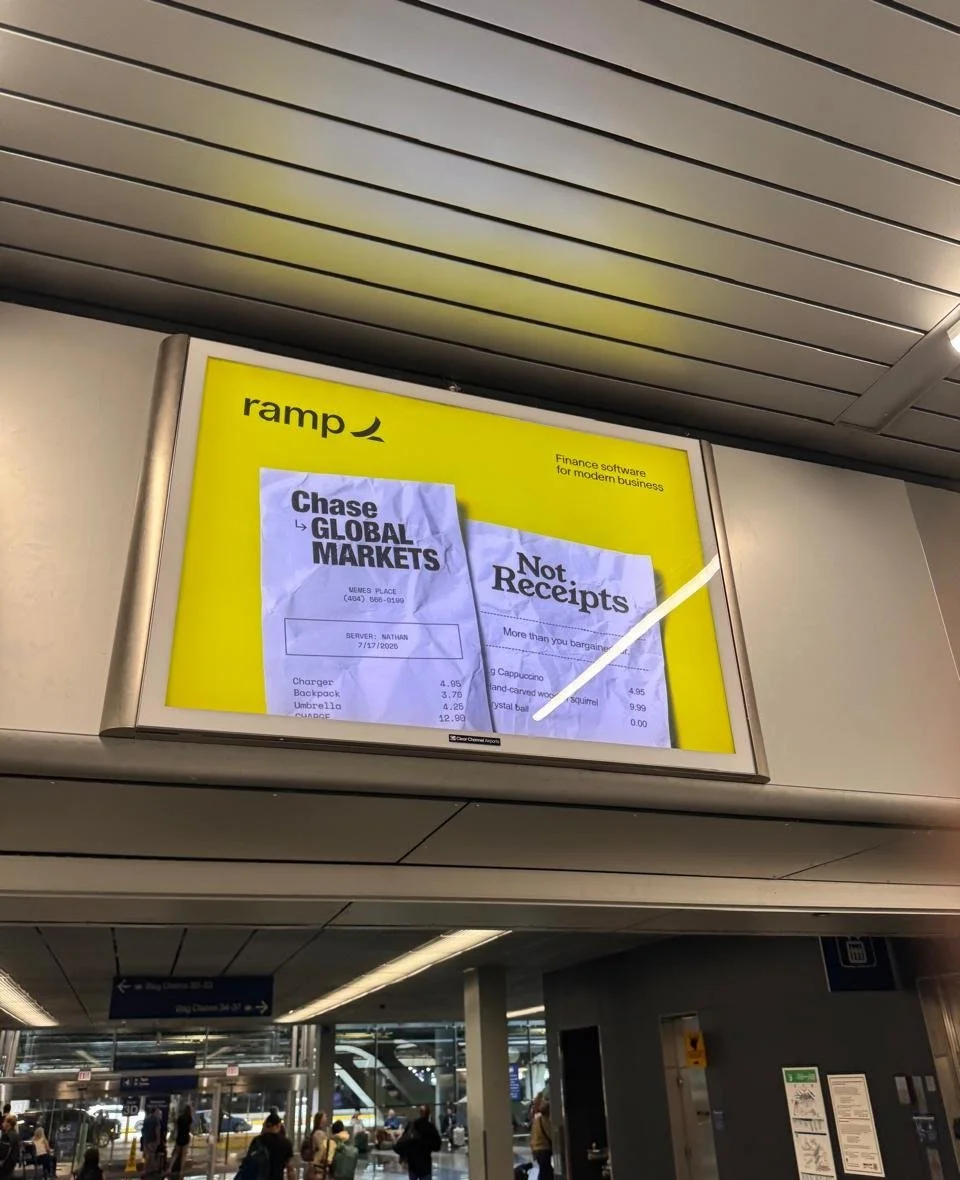
2 · The setting. Grey ceiling slats and wall panels around one block of yellow, above the way out to baggage claim.
That contrast is what pulls the eye. Neuroscientists Laurent Itti and Christof Koch call it visual salience: the part of a scene that differs most sharply in colour or brightness tends to draw the eye first, before any meaning is processed.
Next I clocked two crumpled pieces of paper. I didn’t need to read them to know they were receipts.
That’s schema activation. People carry mental templates for familiar objects, so a receipt is recognised from its form alone: crumpled thermal paper, a merchant line, a date, itemised prices. The creative spends almost no effort establishing what the object is.
The first receipt read “Chase ↳ Global Markets,” and at first I read “Chase” as the bank.
The word can carry its familiar brand-name meaning, and nothing on the board settles it: no Chase logo, no Chase blue, no other Chase branding. The second receipt then says “Not Receipts,” printed on a receipt. This is incongruity: the ad contradicts the expectation it has just built. Neither headline explains itself alone, and the gap between them creates curiosity. George Loewenstein’s information-gap theory (1994) describes this as the discomfort of knowing a specific piece of information is missing. It predicts that a small, defined gap is one people want to close. The expense lines on the second receipt, a hand-carved wooden squirrel and a crystal ball, add to the strangeness.
Then I read the two together: “Chase global markets. Not receipts.”
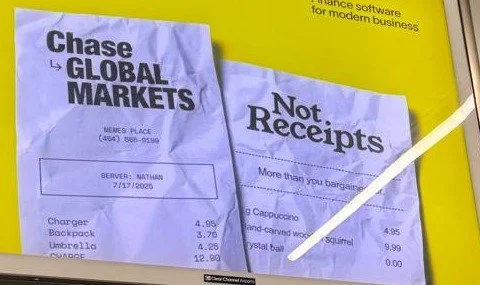
3 · The two receipts. “Chase ↳ Global Markets” on the left; “Not Receipts” on the right, with a hand-carved wooden squirrel and a crystal ball among the expenses.
The joke resolves, and “Chase” becomes a verb. Jerry Suls’ 1972 two-stage model of humour describes this sequence: first an incongruity, then a resolution that makes the pieces fit. Here the resolution also delivers the problem Ramp addresses. The link to the product rests on the logo and the line “Finance software for modern business.”
In Richard Petty and John Cacioppo’s Elaboration Likelihood Model, how deeply people process a message depends partly on their ability to connect it to what they already know. Someone who manages business expenses has a ready link from “not receipts” to a real problem. Someone without that context may take away only a clever receipt joke. This is a hypothesis about audiences, not something the execution proves.
The brand lens
Ramp takes a chore businesses have learned to live with, chasing receipts, and makes it the whole ad. The board shows no software, no dashboard, no feature. The problem is the creative idea, and it’s made physical: two crumpled receipts stand in for a benefit that would otherwise be hard to picture.
The copy then sets that chore against something bigger. “Not receipts” is the state to get away from, and “Chase global markets” is the one to move toward. Read this way, the receipts stand for administrative work, and “Global Markets” for the more valuable work the same people could be doing instead.
The wordplay builds on ground Ramp has already claimed. Since at least mid-2025, the brand’s advertising has been built around chasing receipts: a TV spot titled “Never Chase a Receipt Again,” and a funding announcement headlined “Let the robots chase receipts.” The O’Hare board keeps the verb and points it somewhere new. For anyone who has seen the earlier work, the pun may land on familiar ground.
The yellow belongs to Ramp too. It’s the brand’s signature accent colour, so the colour that wins attention in the terminal is also a brand cue. Byron Sharp and the Ehrenberg-Bass Institute call this a distinctive brand asset: an owned signal people learn to link to one brand. Whether a passer-by makes that link depends on whether they’ve met Ramp before.
The humour appears designed to make a dull problem worth a second look. What the board doesn’t do is say what Ramp does. The only bridge from the joke to the product is the logo and the line “Finance software for modern business.”
The trade-off
The choice that gives the ad its humour also creates its cost. The core message — that receipts are a waste of effort — arrives only when the viewer connects the two receipts and resolves the joke. That takes a few moments and some mental work in a place where people may be heading towards baggage claim or onward transport.
Petty and Cacioppo’s model helps explain why that matters. When people have the time and motivation, they can process a message closely. When they are rushed or distracted, they are more likely to rely on simple cues instead. The full joke rewards close processing; a busy arrivals hall may favour the quicker read.
The simple cues on this board are the Ramp logo and its yellow. So even a glance encounters a brand cue. What that glance may not carry is what Ramp does. That gap is likely to be greatest among people who do not already know the brand. Someone familiar with Ramp’s earlier “chasing receipts” advertising may get there faster.
Memory introduces another possibility. Hedwig von Restorff’s 1933 work suggests that an item that stands out from its surroundings is more likely to be remembered. The bizarreness effect points in a similar direction for unusual details such as the wooden squirrel and crystal ball. Both suggest that the board has elements that may be memorable; neither tells us which element will be remembered — the yellow, the squirrel, the joke, or what Ramp is for.
None of this shows that people missed the message. That’s a question for Test. Structurally, the ad chooses creative discovery over immediate product explanation.
Media & channel
The board is a static lightbox above the baggage-claim area, facing the descending escalator. That position offers riders a few seconds facing it. The format is fixed: no motion, no sound, no room for further explanation, so everything rests on the two receipts and the yellow.
The items on the first receipt, a charger, a backpack and an umbrella, are travel purchases, which suits an airport setting. Whether the board reaches people who handle business expenses isn’t something the placement itself tells us.
The board also sits within a broader advertising language. Yellow is already Ramp’s colour, and “chasing receipts” has been part of its advertising since at least mid-2025, including the TV spot Never Chase a Receipt Again. Ramp has also used Chicago billboards before: its 2022 Doing Finance campaign made a related argument about automation giving finance teams their time back.
For viewers who have encountered that advertising before, this board can function as another expression of a familiar idea. For someone seeing Ramp for the first time, the board has to do more work: the joke communicates the problem, but the product explanation is largely left unstated. Whether that wider advertising was running alongside this board isn’t visible from the board itself.
Test
The question worth testing is simple: does the board work at a glance, or does the viewer need time to connect the two receipts?
1. Control the time
Recruit a few hundred US adults per group through an online research panel, including people who handle business expenses at work. Before showing the ad, ask which brands they know, with Ramp included among other brands, and whether they deal with business expenses.
Randomly split them into four groups, each shown their ad in the original airport photo:
2 seconds: Ramp board
5 seconds: Ramp board
10 seconds: Ramp board
Control: a neutral ad in the same spot, for 5 seconds
Then ask everyone the same questions:
Recall: “What do you remember seeing?”
Brand attribution: “Which company was that ad for?” followed by “What made you think so?”
Message take-out: “What was the ad trying to say?”
The answers show whether people remember the yellow and receipts before they understand the meaning, and whether the two receipts resolve into the intended idea: spend your effort on bigger things, not chasing receipts. For attribution, any answers naming Chase are compared with the control group. That shows whether the double meaning cost Ramp the credit, or whether people were just repeating a word on the board.
2. Test what lasts
A day later, ask the same people the recall question again. This shows whether what people remembered straight after viewing is also what survives: the yellow, the receipts, the odd details, the words, the brand, or the message.
3. How to read it
If two-second viewers mainly remember the yellow and receipts while ten-second viewers are much more likely to understand the message, the Trade-off is supported: the idea rewards time that a passer-by may not give it. If two-second viewers understand the message almost as often as ten-second viewers, the joke works faster than the Decode assumes.
Run the same comparison among people who already know Ramp and those who don’t, and among people who handle business expenses and those who don’t. If either group needs less time to get the message or name the brand, that supports the idea that familiarity with Ramp, or with the problem itself, helps close the gap.
4. What this can’t test
The test tells us how the creative works when people see it for a set amount of time. It cannot fully recreate what happens in a busy airport, where people are walking, distracted and may only glance at the board. Location-based studies can measure OOH exposure, but for one indoor lightbox they cannot reliably tell us who actually saw it or separate its effect from Ramp’s other advertising. The board has no call to action, so signups, demos or trials can’t be traced to it.
Closing thought
The cleverness of the board is easy to see: two receipts, a strange “Chase,” and a joke that makes sense only when you read them together.
Underneath the joke sits its real subject: the time and attention people lose to receipts, and what they could be doing instead. The board makes that problem vivid and leaves the product in the background.
The question is whether people leave remembering the joke, or what the joke was trying to say.
